
The DSA Can't Not Win
And what it means for the Republican Party

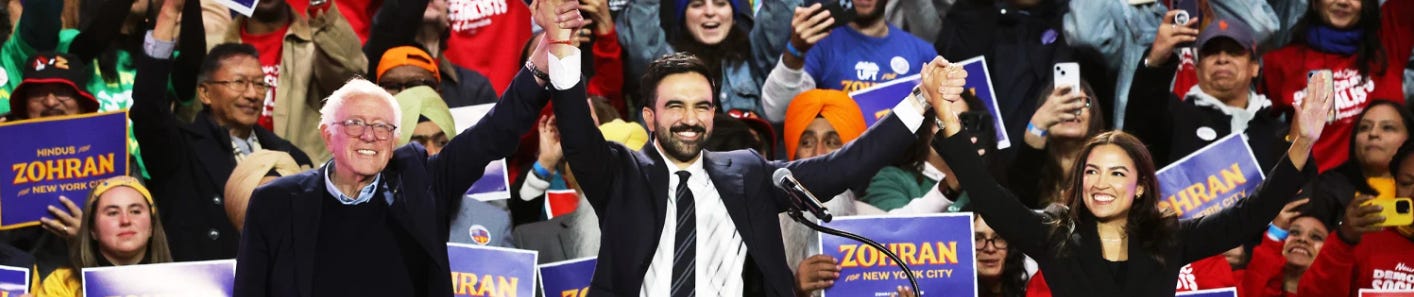
The long-term changes that have taken place in the Democrat Party since the election of Barack Obama in 2008 have finally come to fruition, and we are now in a position where the DSA, or the Democratic Socialists of America, cannot not win — at least within the Democrat Party. The discussions about this ‘radical’ shift within the Democrat Party, at least on the Right, often focus on the rise of demographic blocs of young voters due to immigration. The DSA wing of the party often takes on the moral framework of third-worldism despite not being comprised of many third worlders. You can airlift every Muslim from Dearborn out of this country tomorrow but democratic primary landscape would not change at all. While a shifting demographic landscape certainly has huge consequences for America, especially in elections, the rise of the DSA actually hinges most on the changing electoral preferences of White Democrats, which will likely affect the internal debates that currently roil the Republican Party.
For decades, Republican and conservative commentators have reminded us ad nauseam about the death of the ‘Blue Dog Democrat’. These voters, mainly concentrated in the industrial areas of the Great Lakes (Southern and Eastern European White Ethnics) and the agricultural heartland of the Great Plains (Northern European White Ethnics), were social conservatives who often propped up “moderate” Democrats out of their support for trade restrictions and labor unions. These voters, middle-to-working class and most without college educations, were in many ways the ‘kulaks’ of the American electorate, along with other small business owners who tended already to be Republicans. One of the biggest stories of the last twenty years of American Politics has been the transformation of these people from Bill Clinton and Heidi Heitkamp voters into red-blooded Trump-populists. But this is an incomplete story.
On the Right, the rise of the Progressive wing of the Democrat Party, at least the contemporary iteration of it, has really been understood as a phenomenon related to the rise of racial grievance politics: Black ‘community leaders’ shout about social injustice, police brutality and white racism, in an effort to maximize Black turnout on election day, with Black voters’ monolithic (if not slavish) devotion to the Democrat party leading to Democratic victories. And with the image of the student radicalism of the 1960s and the heyday of groups like the Black Panthers associated with that rise of racial politics, it’s not difficult to see the association. Every time Democrats played the race card in politics, it contributed to the production of a radical, vanguard political identity that gained ever more purchase in the minds of Black Americans.
The production of this racial consciousness may have had the most obvious and widespread early appeal, but it was not the only front in the movement of what became known as ‘Cultural Marxism’. The other aspects of critical theory permeated the academy and the law schools for decades before being noticed by the ‘normie’ political class, finally, during Covid. This process has been noticed by many people, for some years now — but we have to follow the thread straight to the present day.
The principal foot-soldiers of the DSA’s takeover of the Democrat party are not, by number, Black radicals; they are children of the kulaks who made it through the public education and university systems and who emerged convinced of all the slogans and platitudes of the Obama 2008 coalition. In an ironic turn of events, ever since 2019, Black ‘community leaders’ and race-hustlers have been used to wield Black primary voters like a shield against the rising tide of progressivism, overwhelmingly backing more moderate candidates. Old Black voters, whatever they really want aside, steer the party towards Jim Clyburn, Joe Biden and Steve Cohen, not towards Bernie Sanders, Zohran Mamdani or AOC.
Outside of the Deep South (where Democrats are not competitive due to overwhelming White support for the Republican Party), Black voters are nowhere near a majority of even the Democrat electorate — save for a few racially gerrymandered congressional districts. This means that in the vast majority of places where the Democrat Party is actually a competitive force, the dominant faction of their party is actually the increasingly radical White (and white-collar) Progressive faction. This has been the most prominent shift of the last twenty years in Democrat politics; not that Black grievance politics has swallowed a larger share of the electorate than ever before, but that the average White Democrat is more animated by Black grievance politics and the like than they are about bread-and-butter dinner-table issues.
This transition of the Democrat Party from the Party of the Clintons, performatively progressive on social issues and deeply neoliberal on economic issues, to the party of Francesca Hong, revolutionarily progressive on social issues and openly socialist on economic issues, has been animated by the increasingly extreme ideological capture of White, middle and upper-middle class professionals, college educated, who form the backbone of reliable high-propensity voters. The only thing that has so-far slowed the transition of the party from the old to the new have been the old money donors, constituted spiritually by the New York-centered financial scene, and liberal Zionists (not always so different).
The Zionists and the financial class maintained their control over the Democrat Party even as voters exited the sphere of neoliberalism that they were comfortable with by co-opting parts of the new progressive agenda that were not hostile to their immediate and most important interests — that means the LGBTTQIAA+2S agenda, Black grievance, and ever more costly primary intervention. Mostly, they used a carrot-and-stick method of telling their Progressive voters that their preferred candidates could never win (spending tens of millions on ad-buys to do so) and by becoming gay and woke enough to be palatable as an alternative.
In essence, those at the head of the Democrat Party responded to the calls for class war during the Occupy Wall Street moment by redirecting their voters towards race war and gender war; when the class war energy returned, it did not return alone, but as the full fruition of all three at the same time — DSA.
But the failure of Kamala Harris’ almost neoconservative (at times) presidential run and the ever-increasing unpopularity of support for Israel and Zionism have combined in the primary landscape of the Democrat Party like a witch’s brew perfectly concocted to finally allow the Progressives to take full control of the party. Because of the Republicans’ precarious position with regard to Trump’s second-term midterms, the unpopularity of the Iran War and the flawed economic situation, DSA candidates have a good shot at winning important races in November. Victories now would mean that the Neoliberal wing of the Democrat Party, increasingly radical in its own right, would be left in the lurch without the (convincing) use of their best argument.
There is a good chance that Francesca Hong, Abdul El-Sayed and their aligned candidates win in November — if they were Jane Democrat (because let’s be honest, the generic Democrat is a woman, and certainly not named John) they would each be the easy favorite in their respective race. If they don’t win, though, it doesn’t really matter — it’s too late for the Democrat Party to reverse course. Their core electorate is already too radicalized, the tipping point is long since passed and the consequences will be realized within the next six years. Ironically, the only things keeping the Democrat Party ‘moderate’ are Boomers, Jews, and Hispanics. Black voters might be voting, mostly, for more establishment types, but their votes rarely matter to the trajectory of the party except during the presidential cycle, and they require an ever more annoying and destabilizing diet of racial grievance to keep energized, which feeds the beast of the DSA-wing in the long term by radicalizing Whites with intersectionality and critical race theory.
The flight of the ‘moderate’ elements from the Democrat Party will not necessarily be a good thing for the Republicans either; it will present real and complex problems for our movement with more than a few of its own crises already underway. For one, we’re staring down the barrel of a lot of donors, and a lot of their money, stampeding into our party with a single objective: not to let the last bastion of support for Israel perish from the political scene of the United States. The second pressing goal they will have is to make the party suitable to themselves and their political vision.
The first wave of this phenomenon is long passed, we all know the Bari Weiss and James Lindsay types, and while they occasionally contribute arguments against the Democrats, they spend a great deal of effort making sure that our party and our movement are continuously remade in their image, and disfigured from the kind of movement which would have any hope of actually saving America. Many of the financial and Zionist types may not have abandoned the Democrat Party, but some of them did— and they threw hundreds of millions of dollars towards the election of Donald Trump, money he desperately needed, and surely secured them at least a sympathetic ear in the White House. When the rest flee for our safe haven, we can anticipate only an increase in the fervor and hysteria surrounding questions of foreign policy restraint and decoupling from the Middle East.
In short, there will soon be another influx, if not a deluge, of neoliberals (turned neoconservatives?) begging, screaming, and most importantly spending, massively spending, for the return of John McCain and Mitt Romney’s Republican Party. They will position themselves against JD Vance, if not Trump himself, who it is stupid to oppose publicly, and they will have no where else to go, because by now the DSA can’t not win.
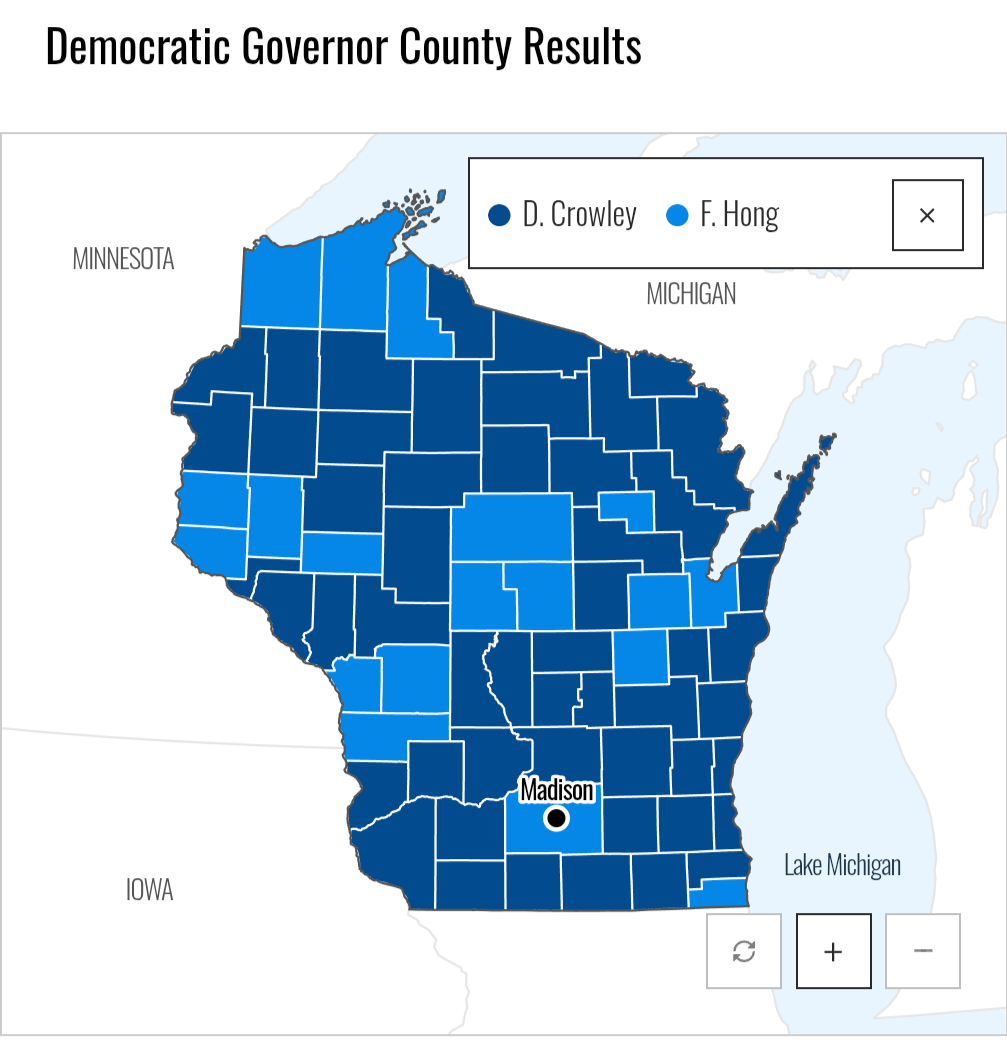
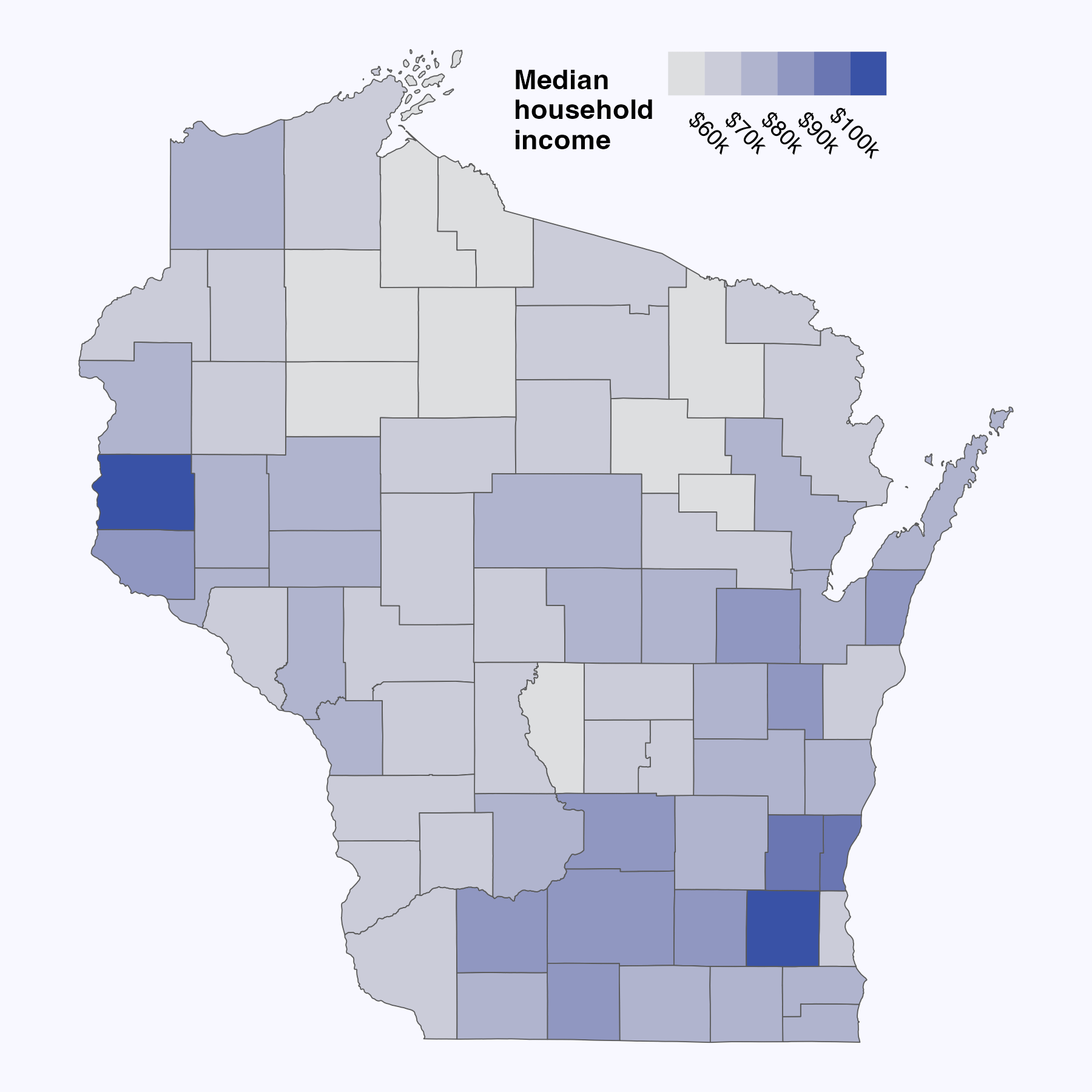
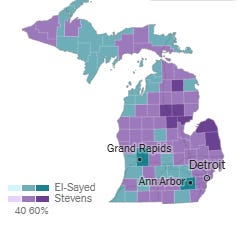
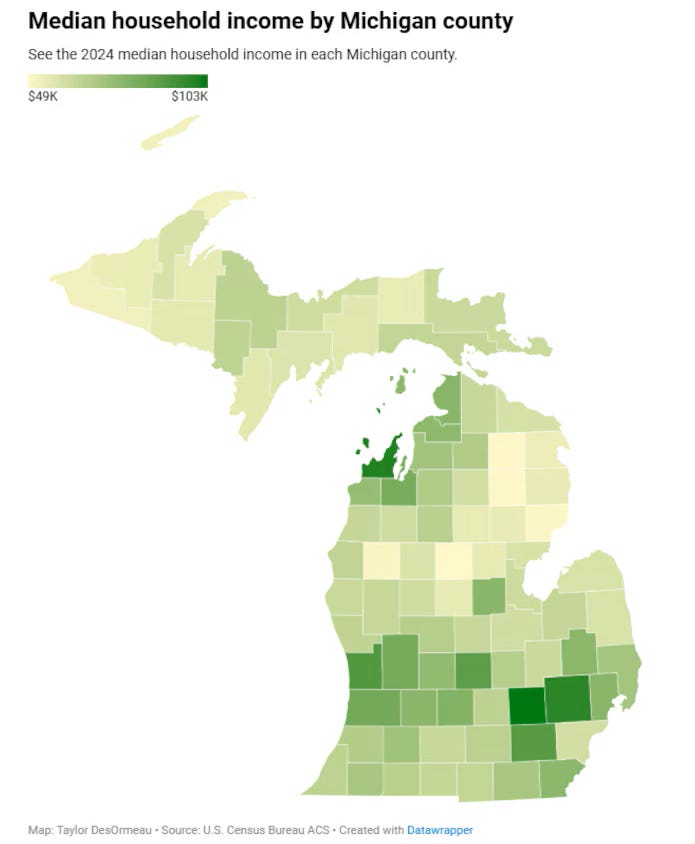
It's true that many of the leaders of the DSA are minorites, but that's best explained as a function of the self-hatred of the Whites who vote for them. A comparison of the counties that voted for El-Sayed to the county-by-income map of Michigan will show this.
I think what’s important to remember is that even though Zionists have money, they don’t have leverage, there’s nowhere else for them to go. Because of that when they give us lectures on affordability and burritos we should tell them to shut it and if they want their evil wars and handouts to their country they have to give us something.